Research Overview
(Bob’s Burgers, 2011)1
For the Emerging Technologies Research Proposal, I wanted to centre my project on the American animated TV show, ‘Bob’s Burgers’.
Based on the workshop tasks that I completed, I explored the different ways of immersive design through the use of those exercises. I experimented with creating immersive designs within VR and AR, but ultimately decided that I want to create a VR 360° scene.
My initial idea was to create a simple non-moving 360° scene within the Bob’s Burgers restaurant with random events relating to the animated show occurring throughout the video; however, I decided against this as I thought that being restrained to a small restaurant would limit the number of things I could create which, in turn, makes it difficult to produce an immersive VR video. Therefore, with the help of previous sessions during the workshops, I came up with the idea of creating something like a ‘ghost train’ but without the horror aspect.
By creating a kart and attaching a VR camera to the object, I plan to use MASH to create a path for the kart to follow through the scene. With the use of a kart to guide the viewer throughout the scene, I can replicate a ghost train with little occurrences throughout the ride to create an immersive VR experience.
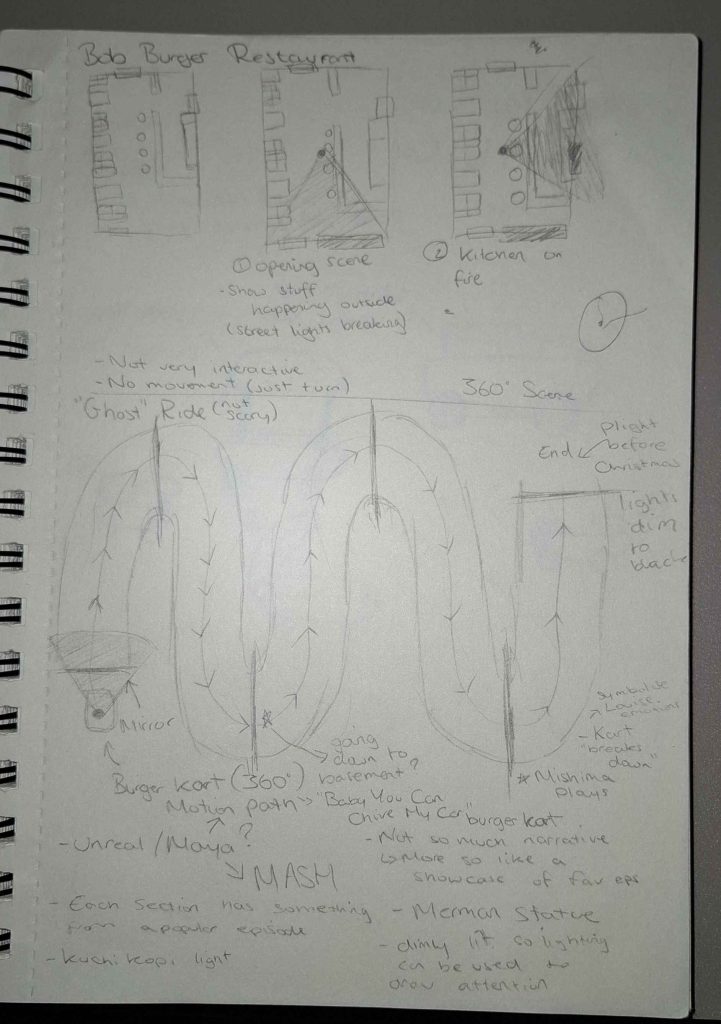
As shown in the photo above, I want to create a route for the kart to follow with references to the animated show to appear throughout the ride. I plan to create this within Maya to utilise the MASH dynamics tool to create an immersive VR 360° video.
To do this, I needed to research different VR roller coaster videos and analyse their differences and what aspect of their video makes it immersive. I looked at both VR and real-life 360° ride videos to broaden my research which are shown below.
I believe that the ‘Mario Kart Dark Ride’ is the most suitable for my production piece as it’s a slow ride and not a fast roller coaster, which is beneficial as I need to maintain a slow speed to minimise motion sickness. However, in terms of immersion, I believe that the ‘Mario Kart Dark Ride’ excels at an immersive experience due to their use of AR and how they utlise AR glasses to simulate the Mario Kart game with items and characters; aside from the AR, the environment of the ride is meant to imitate a map with the use of the countdown, obstacles, lighting, SFXs, etc. This helps to create an immersive experience as you enter the roller coaster as though you are playing the Mario Kart game.
Another video I looked at is the ‘Rainbow Roller Coaster’ which provides an immersive experience through the use of bright colours and SFXs; however, I believe that using bright colours produces a ‘noisy’ and unappealing experience as I struggle with motion sickness and the obnoxious use of flashing colours would be difficult to endure. I did, however, like the use of the butterfly assets and how they landed on the kart which gave the butterflies life as they were not looped doing the same thing.
Additionally, after watching the ‘Sea Life Planco’ video, I found it difficult to keep up as the speed of the roller coaster was constantly changing from slow to fast and back to slow again, which was very nauseating to look at. However, for those who do not experience motion sickness, the use of speed creates a realistic immersive experience as the kart tends to slow down to allow time for the doors to open, allowing them to enter to the new area before slowly speeding up again. I liked the idea of the doors opening, which made me think of the MASH dynamics of the warping wall effect which is what I wanted to add in my production piece.
As for the other videos, I notice that there are references to their respective theme throughout the ride which is useful to take into consideration when creating my production piece. As my theme is Bob’s Burgers, I aim to add assets that reference the show that Bob’s Burgers viewers will enjoy.
UX Considerations
As discussed in the lab sessions, people who experience motion sickness may struggle with the immersion within virtual reality; therefore, it is extremely important to consider some design principles that could help minimise the effect of motion sickness for viewers. As my VR experience requires the VR camera to move following a path (as well as allow the viewer to turn 360°), it may cause some discomfort for the viewer.
Upon further research, I found that there are numerous ways to reduce the problem of motion sickness within virtual reality. One of the main examples of this would be to create a ‘Stationary Reference Point’ (Interaction Design Foundation, n.d.)8; as my project requires the viewer to be constantly moving, I would need to create a fixed point, like a wall, for the viewer to stare at to signal to the brain that the viewer is stationary. As discussed within the lab sessions, I would be using the kart that the viewer is ‘sitting’ on as the stationary point which allows them to simply look down to relieve the nausea.
Furthermore, as the kart will be in constant motion, I would maintain a slow speed so that the viewer has the time to take in the environment surrounding them without needing to spin around extremely fast to keep up; this would also allow the viewer to take their time when looking around so they’re not missing out on things happening around them.
To produce an immersive VR experience, it is important to consider the VR design principles to inform myself about what makes a VR experience immersive; the way to do this is by utilising the two senses: sight and touch. I came across a website which goes into detail about how to create an immersive experience within VR, which they talk about ‘Multi-Sensory’ (Samuel Page & Andrew Measham, 2023)9. As my production piece won’t require haptic input, I will only be focusing on visuals and audio.
In terms of visuals, I plan to use colours that are soothing to the eye and nothing too bright that becomes blinding, or anything that’s too dark which will prompt the user to strain their eyes to focus.
As noted during my research, a 360° view gives the user a large spatial surrounding to turn in any direction they want; however, when creating an immersive video, it is important to consider guiding the user to look in the direction where something is happening.
“The more there is to see, the less the audience remembers.” (VR/AR Media Experiments, 2016)10.
This means that if there are too many things happening across the scene, it’ll be difficult for the user to keep up and take note of what’s happening around them. With the use of lighting, however, I am able to direct the user’s attention towards wherever the light is point towards; this can help maintain their attention and guide them to something that’s happening in the scene so that they’re not missing out on any details.
Regarding audio, I plan to implement music and SFXs during the post-production stage. I would like for the SFXs to be spatial audio, but Maya does not have the option for that; therefore, I intend to edit the audio in Adobe Audition and change the output to either left or right depending on where I’d like to guide the user’s attention to. However, I can see that there can be an issue with this as, for example, if I assume the user is facing forwards and I have the SFX play from the left speaker, this will prompt the user to face left but even if they face left, the SFX will continue to play from the left speaker if they are looking at the source straight on. Depending on how the outcome appears, I may have to remove spatial audio to avoid confusion for the user.
In terms of music, I plan to implement music that’s used in the Bob’s Burgers soundtrack; this will appeal to viewers who have already seen Bob’s Burgers and recognise their iconic tunes. This will consist of the Bob’s Burgers intro theme song as well as ‘Mishima (Bob’s Burgers Arrangement)’ from their most popular episode ‘The Plight Before Christmas’.
Ethical Considerations
Despite the animated series ‘Bob’s Burgers’ being rated PG 13, I would like for my production piece to be enjoyed by all regardless of age. Therefore, my production piece will be aimed towards the general audience and people who enjoy the animated show, but specifically people who have seen and enjoyed Bob’s Burgers. As this is targeted to people of all ages, I will keep it PG to ensure that the audience enjoys the experience and will not find anything offensive; this will consist of creating assets and finding appropriate SFXs to be in the production piece.
Furthermore, it is also important that the viewer doesn’t strain their eyes during the experience; to avoid this, I need to ensure that the lighting for the video is optimal. Although I will be needing dim lighting to draw attention to events, I may need help with additional lighting to ensure that the scene is lit appropriately without taking away from the immersive experience of the theme ride. I also need to think about the opposite, to not have lighting that’s too bright as that can also trigger eye strain for the viewer. I intend on testing throughout production to ensure that the lighting will come out right.
Visuals aside, it is important to consider the audio that will be implemented in my production piece. The intention of the production piece is to create an immersive video which cannot be done without the use of audio. To ensure that users who view the video have a comfortable and enjoyable experience, it is crucial to keep the audio levels to a suitable level; this means, avoiding the use of sudden jumps in pitch that may scare the user. Ensuring a suitable level for audio level will be extremely useful for people with sensitive hearing.
Project Plan
Timeline
I created a gantt chart to help keep myself on track with the project, separating each task out by weeks.
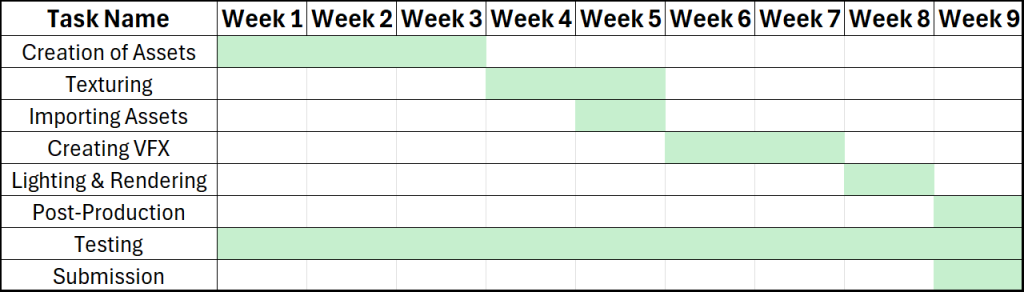
As I plan to create my own assets, I will be needing a considerable amount of time creating them. I’m expecting to come across a few issues when creating assets, so I will be giving myself 3 weeks to complete them before moving onto the texturing stage. During the texturing stage, I will be completing them and putting each asset back into Maya to ensure that it works and that there aren’t any mistakes before properly importing them into the main project.
I will need time to create the tracks for the kart to go through using MASH dynamics and the overall environment of the production piece, this will hopefully take about a week to ensure that the textures on each asset are correctly assigned and that the assets are positioned according to the plan if no issues arise.
My next steps will be to create VFX for the video which hopefully won’t take too long as I have only 4 VFXs that are needed in my production piece, but I have given myself 2 weeks in case any issues come up. If I manage to finish quicker, it will give me some extra time to assign myself to another task that needs taking care of. Throughout the entire production stage, I will be testing to ensure that everything is working correctly and attempting to do minimal lighting before adjusting it at the end for rendering.
Once the rendering has finished, I will be putting the render through into Premiere Pro where I will begin the post-production stage; this stage will consist of adding audio such as music and sound effects where appropriate.
Milanote
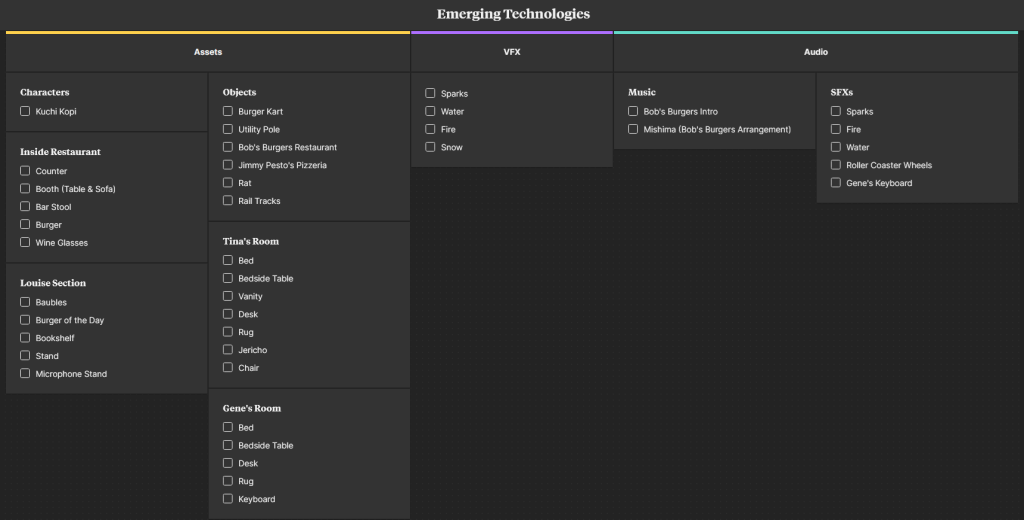
Within the website Milanote, I have created separate lists of things to do during the production stage. These lists are split up into assets, VFX and audio. This will help me manage my time as well as reminding me what needs to be completed.
Concept Storyboard
The concept for my production piece is a Bob’s Burgers themed ride. To make an immersive 360° VR video, it is crucial that it is visually pleasing.
When discussing ideas for my production piece, I raised an issue that I was concerned about which was the amount of time that would be spent on creating assets; the solution to maximise efficiency was to create low poly assets. I was then shown a tutorial that created Funko Pop characters which I was advised, and plan, to follow to help with efficiency in the creation of characters.
To ensure that my concept is depicted fully in a way that can be understood, I created a storyboard to help envision my production piece. However, I believe that it was difficult to properly capture the immersion of the 360° perspective, so I looked at other ways to create a storyboard that can accurately encapsulates my ideas for the narrative of my video.
I came across a reiteration of a 360° storyboard format which consisted of a front, rear and top-down perspective POV. I thought that this would be a great way to portray my ideas, but rather than using front and rear, I would use a left and right point-of-view; this is because, despite this being a 360° video, I want to limit the amount of spinning around that the viewer would have to do to minimise motion sickness.
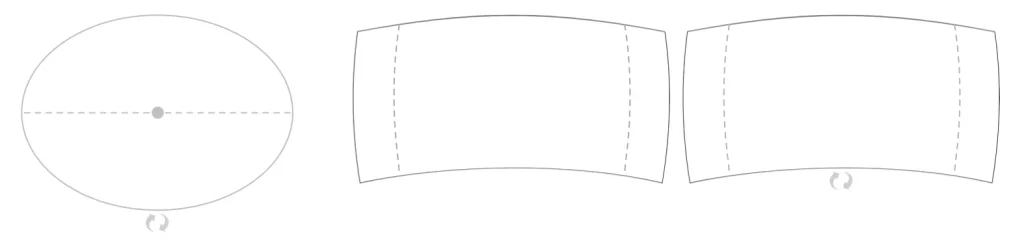
Storyboard
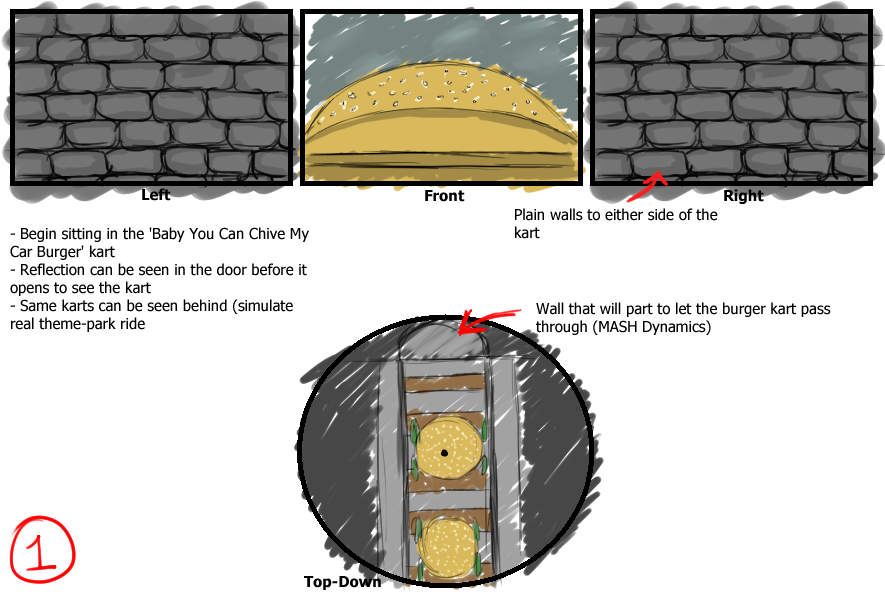
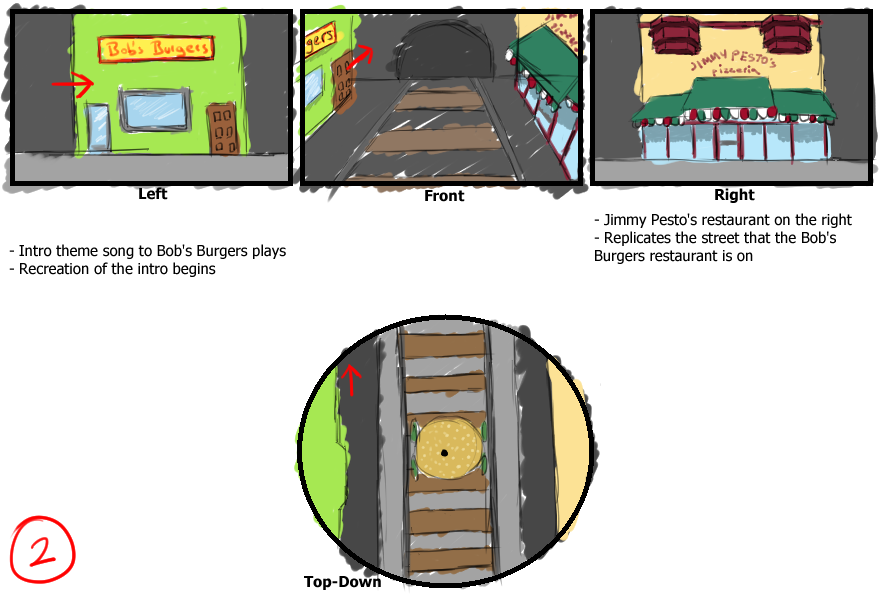
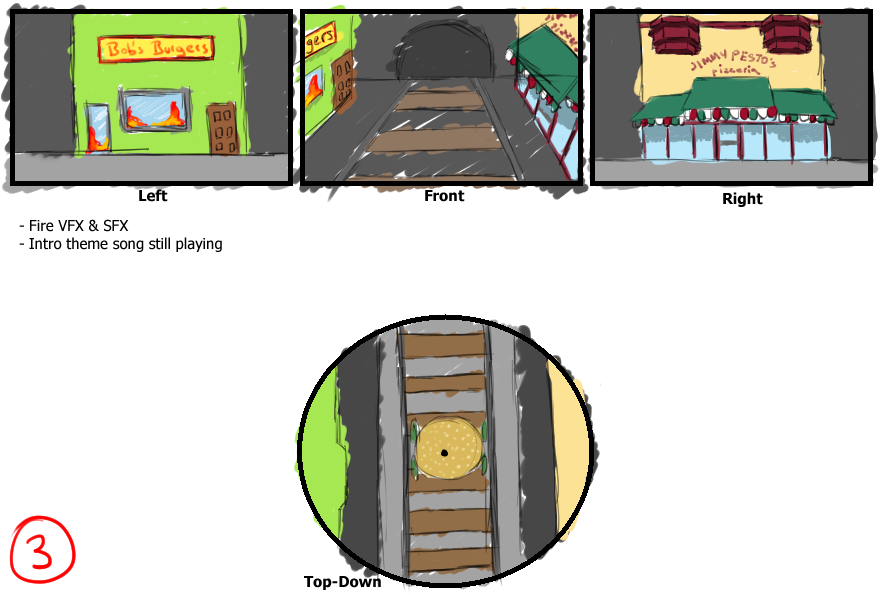
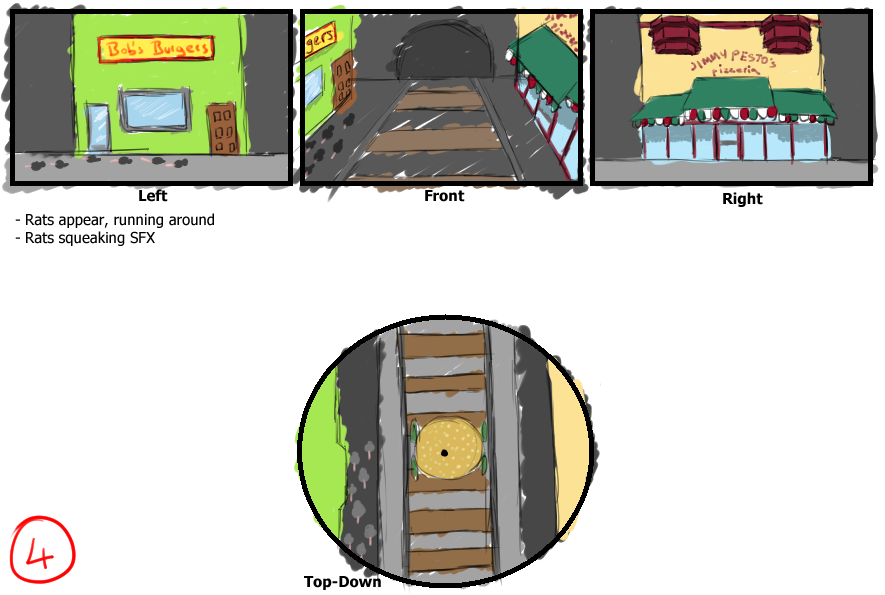
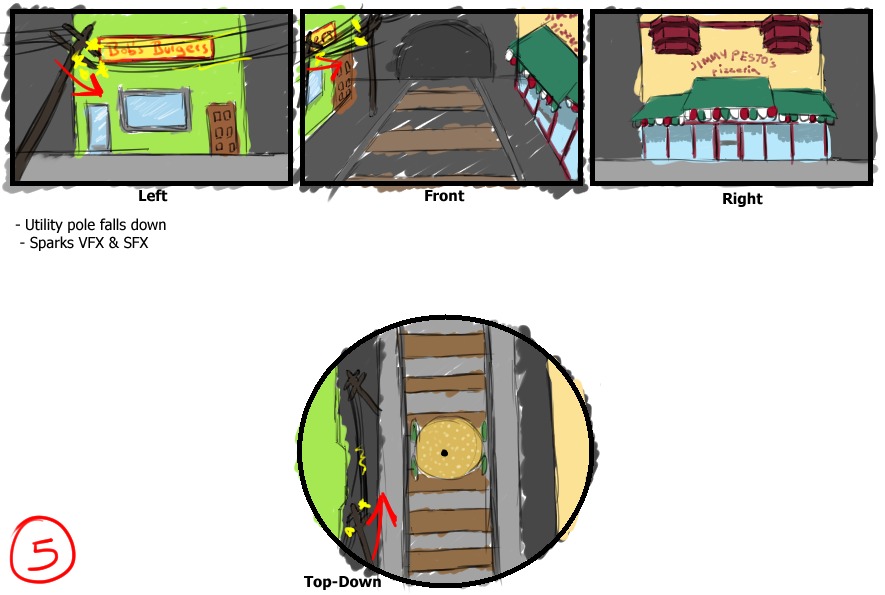
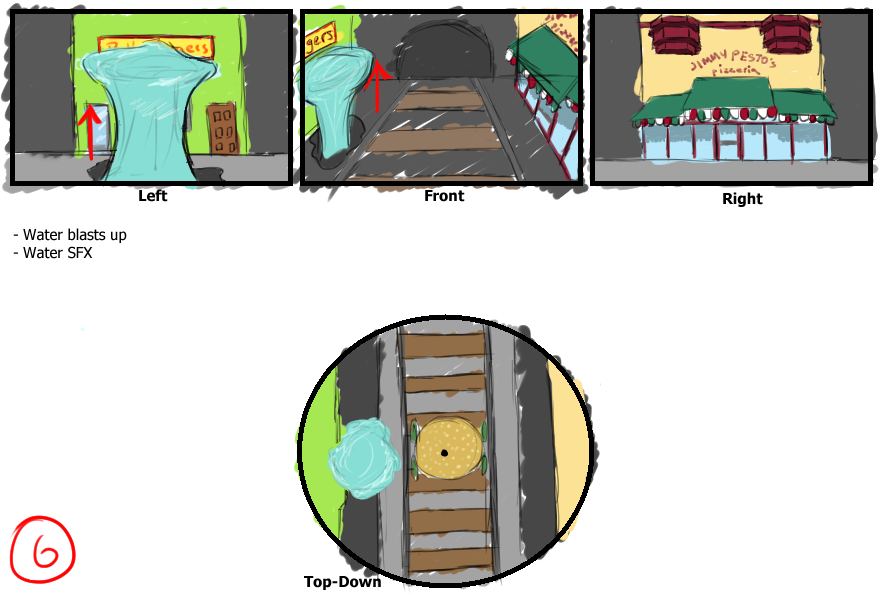
The first section of the 360° video will be a recreation of the Bob’s Burgers intro. To ensure that the viewer can see the entirety of the beginning without missing anything, the burger kart will stay stationary for the duration of the intro.
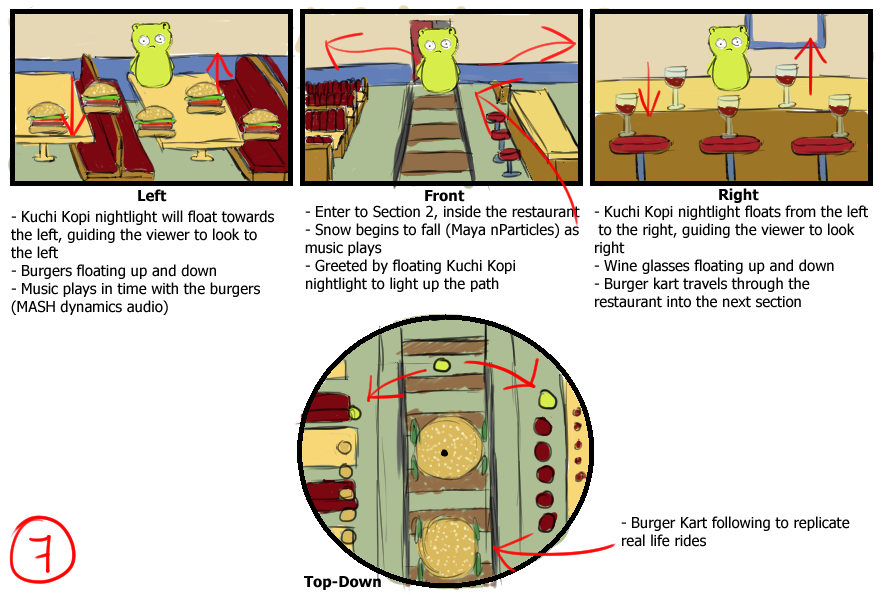
Moving onto the next section, it will be an insider view of the Bob’s Burgers restaurant; within the restaurant will consist of things relating to the main characters Bob and Linda. As the kart passes into the next section, the Kuchi Kopi nightlight will appear. The kart will pass through the inside of the restaurant and the music ‘Mishima (Bob’s Burgers Arrangement)’ will play with Kuchi Kopi guiding the viewer to look at the movements around them.
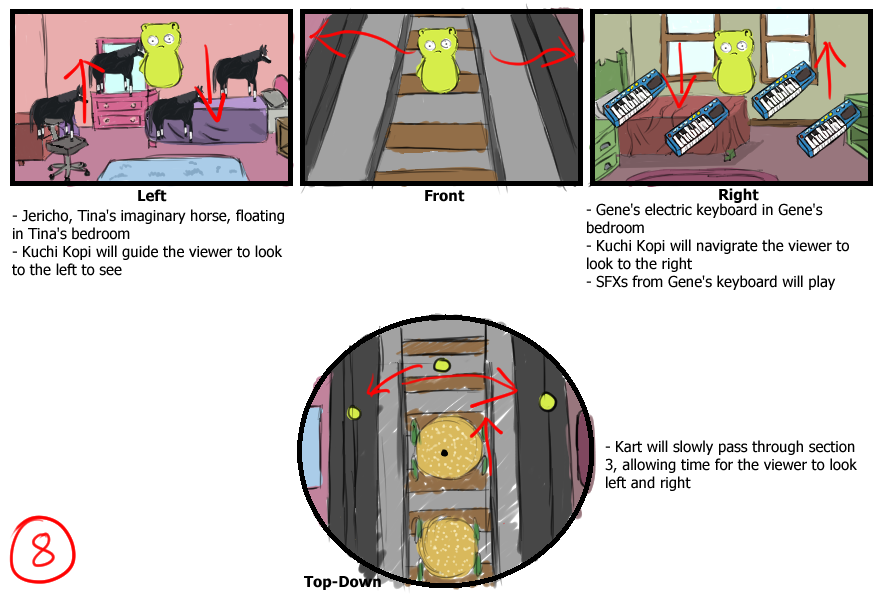
In the third section, it will consist of references to the main characters Tina and Gene. For this section, I decided to split it in half, the left will be Tina’s and the right will be Gene’s.
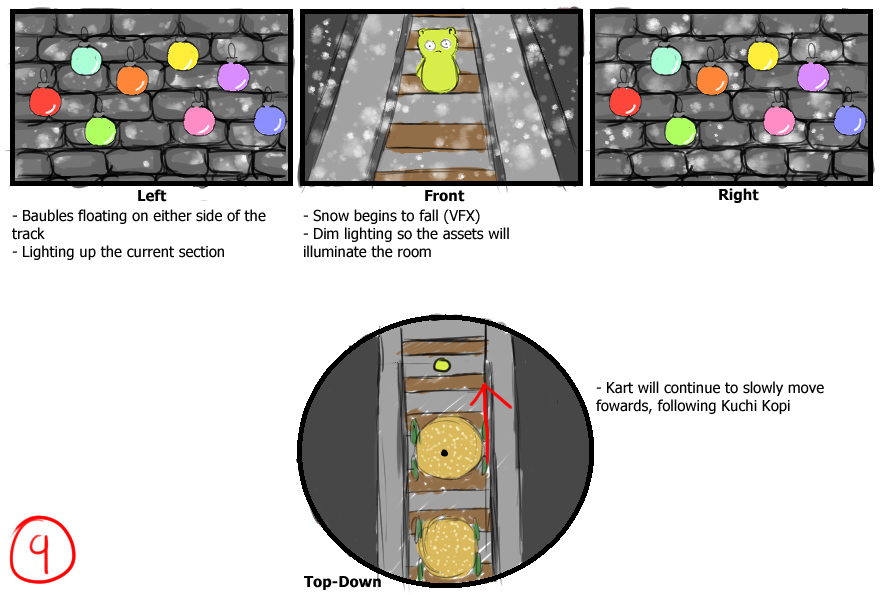
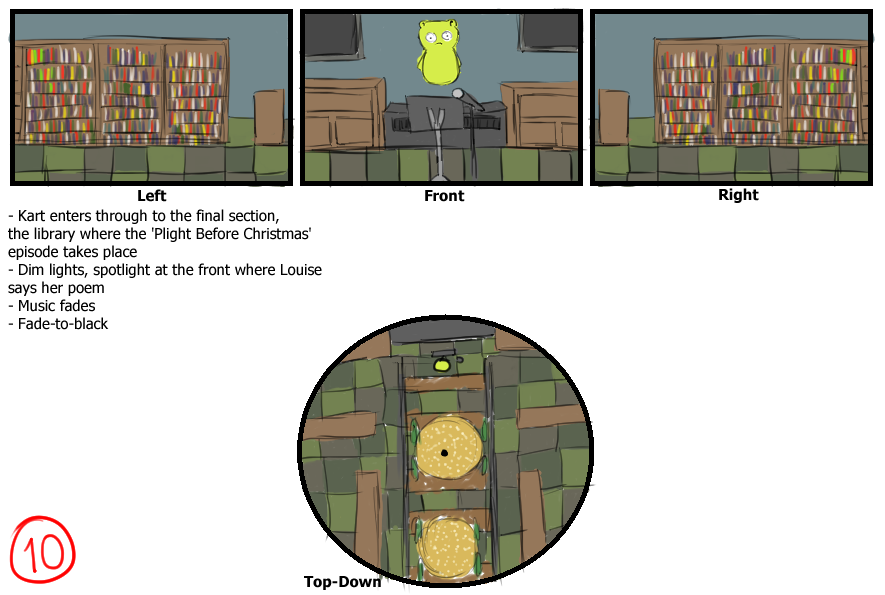
For the final section, I would like for it to tie up with the music that’s being played ‘Mishima (Bob’s Burgers Arrangement)’ from the episode ‘The Plight Before Christmas’; this will take the viewer to the library to where the episode takes place, and ultimately end there with floating baubles and snow VFX.
As the production piece must be immersive, it is important to take colours into consideration to ensure that I have the viewer’s full attention during the entire video. As the majority of the production piece is a recreation of Bob’s Burgers, I will be using the same colour palette which is full of bright, but not too blinding, colours. As for the baubles in the final section, I intend for them to have a similar glow to Kuchi Kopi to add more lighting to the final scene.
I intend on the production piece to be approximately 2 minutes long, as the duration for the audio for both the theme song and ‘Mishima (Bob’s Burgers Arrangement)’ totals up to about 2 minutes. Furthermore, upon researching immersive 360° videos, I didn’t want to have too many things happening around the viewer as they may forget things that happen if there are too many events; therefore, I plan to have the kart move slowly for each section allowing at least 20 seconds to view each area before moving onto the next section.
In terms of lighting, I plan to have dim lighting for the entire duration of the ride as I intend to use the Kuchi Kopi nightlight to guide the viewer to look at the events that are happening around them, to ensure that they are not missing out on anything. Although, if the scene is too dark in the render, I will be adding warm spotlights to draw more attention on the things happening around the viewer. With the use of dim lighting, I can avoid creating a blinding glare when drawing attention to my assets as they will mostly be textured will bright colours that match the Bob’s Burgers colour palette.
As the production piece will be split up in sections, I plan to do them separately to avoid slow rendering and lag when working within Maya and then putting them together in the post-production stage.
Conclusion
Although my production piece is catered towards people who have already seen Bob’s Burgers, I’d like to have features that appear fun and enjoyable to those that, despite having not seen it, would still enjoy the VR experience.
I feel as though the Bob’s Burgers ride would be a great opportunity for people who haven’t seen Bob’s Burgers to enjoy the immersive experience, compared to my first idea of a simple stationary 360° video; as I struggled to think of things that could be added to the scene as I felt very restricted.
With the use of a theme ride, I can create an immersive 360° video as it takes the viewer around the ride and showcases fun objects relating to Bob’s Burgers!
- Bob’s Burgers (2011) Loren Bouchard & Jim Dauterive [TV Programme]. FOX, 9 January. ↩︎
- Attractions 360° (2023) Mario Kart Dark Ride at Universal Studios Hollywood | Without & W/ AR Glasses | Super Nintendo World [Video]. Available online: https://www.youtube.com/watch?v=NPfJA9i8W-o [Accessed 15/12/2024]. ↩︎
- VR 360 (2021) 🔴 VR 360° Super Mario Roller Coaster [Video]. Available online: https://www.youtube.com/watch?v=g1lr94t4sdI [Accessed 15/12/2024]. ↩︎
- VR 360 (2024) SpongeBob Roller Coasters VR 360° 8K [Video]. Available online: https://www.youtube.com/watch?v=PN0leM2eGuA [Accessed 15/12/2024]. ↩︎
- BRIGHT SIDE VR 360 VIDEOS (2021) 360 VR Rainbow Roller Coaster | Videos 4K | Gymnastics for the eyes [Video]. Available online: https://www.youtube.com/watch?v=kmhfyahvx5E [Accessed 15/12/2024]. ↩︎
- WULFI (2020) 🟨 Disney Castle Roller Coaster 360 VR POV immersive virtual Reality 4K 3D ride [Video]. Available online: https://www.youtube.com/watch?v=f9ZHi5A5Jgk [Accessed 15/12/2024]. ↩︎
- HIKAWA RIDES (2021) 【4K60P】プラネットコースター 水中ジェットコースター 「シーライフプランコ」/ “SEA LIFE PLANCO” Roller Coaster at Planet Coaste [Video]. Available online: https://www.youtube.com/watch?v=UYJIqBZENjU [Accessed 15/12/2024]. ↩︎
- Interaction Design Foundation (n.d.) Cybersickness in Virtual Reality. Available online: https://www.interaction-design.org/literature/topics/cybersickness-in-virtual-reality [Accessed 15/12/2024]. ↩︎
- Samuel Page & Andrew Measham (2023) VR Design Principles. Available online: https://www.seymourpowell.com/lab-stories/vr-design-principles [Accessed 15/12/2024]. ↩︎
- VR/AR Media Experiments (2016) The Storyteller’s Guide to the Virtual Reality Audience [Blog Post]. 6 April. Available online: https://medium.com/stanford-d-school/the-storyteller-s-guide-to-the-virtual-reality-audience-19e92da57497 [Accessed 15/12/2024]. ↩︎
- Grant Abbitt (Gabbitt) (2020) Deadpool Character – Part 1 – The Head – Blender 2.8, Deadpool character – Funko pop style [Video]. Available online: https://www.youtube.com/watch?v=WY8e86osp3s&list=PLn3ukorJv4vtf9E9IQk7Acbe7cKkEnuyk [Accessed 15/12/2024]. ↩︎
- Andrew Leitch (2017) A Storyboard for Virtual Reality [Blog Post]. 5 January. Available online: https://medium.com/cinematicvr/a-storyboard-for-virtual-reality-fa000a9b4497 [Accessed 16/12/2024]. ↩︎